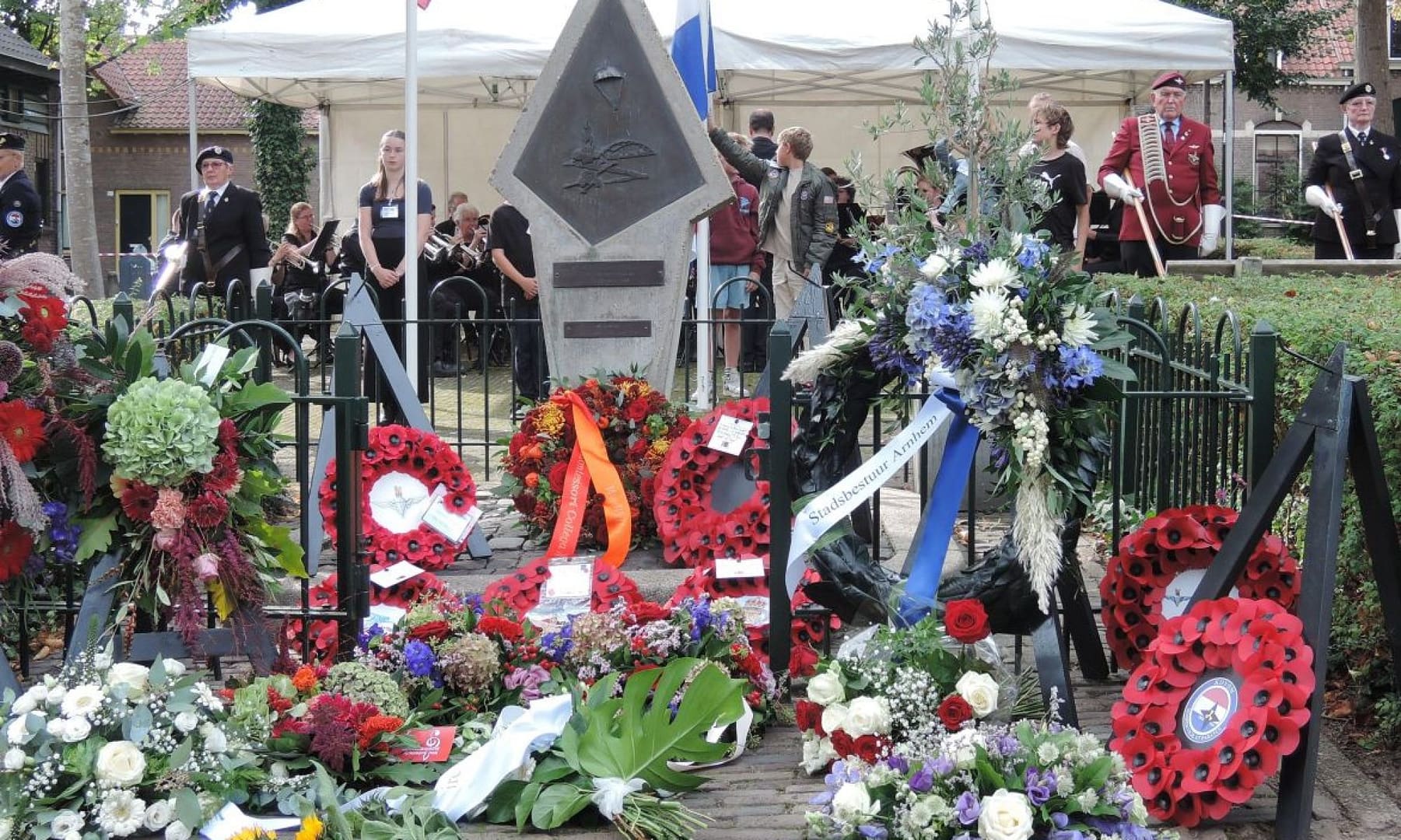
Music by the West Arnhemsche Muziekvereeniging led by Geert Jan Dijkerman
Word of Welcome By Ben Kolster
Dear attendees, good afternoon. On behalf of the Arnhem-West Airborne Commemoration Committee, I would like to welcome you all. My name is Ben Kolster and I am your host this afternoon, during the Airborne Commemoration 2026, here in Lombok, taking place for the 10th time this year.
In particular, I would also like to welcome, the Alderman of the City of Arnhem, and Mr. van der Linden, accompanied by his wife, who is our special guest this year on behalf of the Arnhem West district.
We also extend a special welcome to Mr. Keith Allen, the Deputy Ambassador, of the United Kingdom of Great Britain and Northern Ireland in The Hague. Major General Ollie Kingsbury, The Colonel – Commandant of The Parachute Regiment and to Mr. Hugh Adsett, the Canadian Ambassador to The Netherlands. With his presence we also commemorate the CanLoan officers who died in these parts of Arnhem during the Battle of Arnhem in September 1944. The CanLoan officers were Canadian officers attached to British units. We also welcome Colonel Janusz Sroka from the Embassy of Poland. Thank you all for being here this afternoon!
We would also like to extend a very special welcome to the students and teachers of the Montessori College Arnhem who are here today. The Montessori College Arnhem has officially adopted this monument “Remember September 1944” for a number of years, and they have received the recognition of the National Committee 4 and 5 May. Boys and girls, thank you for being here with such a large group.
Also, a very warm welcome to the youth of Poland, assembled here by the members of the well-known music group “Promyki Krakowa,” “The Sunrays of Krakow”, led by Mrs Romana Krzemien. “Serdecnie Witamy Promyki Krakowa, wetamy Pania Krzemien”.
Why do we hold this commemoration in Lombok today and especially, what do we commemorate?
Military historians are almost unanimous in agreeing that the Battle of Arnhem, which began yesterday, 82 years ago, reached its dramatic turning point on September 18th and 19th. They probably lost on the nearby Utrechtseweg and Onderlangs, and in this district of Lombok. It was on Tuesday September 19th that the British 11th Battalion of the Parachute Regiment, together with the 2nd Battalion South Staffordshire Regiment, fought a heavy battle here in Lombok. Eventually, the 11th Battalion was decimated to 150 men from the almost 600 who had started the fighting, when it had to retreat to Oosterbeek.
It is these men that we commemorate this afternoon. But we also remember the civilians who died in this district of Arnhem because they were trapped by the fighting.
Now that the generation that experienced the war is gradually disappearing, it is good that especially you, the students of the Montessori College Arnhem, as the generation that represent the imaginary “Bridge to the Future”, continue to reflect on the sacrifices that were made then. We see in the news every day that the inviolability and freedom of a country, and the maintenance of universal human rights, cannot be taken for granted. That is why it remains topical to remember the struggle for freedom, and that is why it is so good that you are here this afternoon.
Entering of Standard Bearers en Pipes and Drums
“Ride of the Valkyries”
Speech by Mirjam Stuiver, Director of the Montessori College Arnhem
A warm welcome, also on behalf of the Montessori College Arnhem. It is nice that you are here again with so many people at this commemoration of the Battle of Arnhem, now 82 years ago.
We are here in a special place, in the middle of the Lombok district, a beautiful 19th century working-class neighbourhood. At first glance, you would not think that this is the place where heavy fighting took place on the 18th and 19th of September 1944 when the British troops were stopped by the German occupiers on their way to the bridge. Only a quarter of the British soldiers who fought here survived this battle. Residents of the neighbourhood assisted the British soldiers, though there were also many casualties among those civilians.
Every year we commemorate all the fallen here and show our gratitude for what they did and what they have meant to our freedom. We must continue to do so, and I think it is important that we as a school are part of this.
Our school is located on the Utrechtseweg, a few hundred meters from here, and was in the hands of the Germans during the war. The history of the surroundings of our school makes us feel especially connected to this commemoration. Every year our students and teachers are actively involved, and partly because of this the youth committee was created. We are very proud of that.
“Freedom is not without obligation” is the message that the youth committee wants to give to the young people of our time. A beautiful message, which shows that as Montessori students they have developed into independent young adults, willing to take responsibility in society with their own talents. For me, this is one of the most important goals of our education. They are aware that we owe our freedom to the soldiers and civilians who gave their lives here. This freedom means that we live in a country where you can be yourself, regardless of your origin, philosophy of life, or sexual orientation. A freedom that allows you to express your opinion, to stand up for equality, in which you are curious about the other, without immediately judging. And we all know that this freedom is not to be taken for granted, that this is something we have to work for. That is not without obligation!
Today we consciously reflect on the events of the past, we honour the warriors by laying flowers. And in doing so, we strengthen the connection with the present, as a bridge to a hopeful future, in which everyone can live in freedom.
Speech by an MCA student, on behalf of Mr A. van der Linden
Introduction by Ben Kolster:
Ad van der Linden was 8 years old during the Battle of Arnhem and is present here with his wife.
His memories are read aloud by: A student of MCA.
—————————————————
I lived with my parents and big sister on the Zuidelijke Parallelweg in Lombok. My father worked for the railways. Our house was right on the railway.
On Sunday 17 September, we heard many planes in the sky and from the Oranjebrug we could see the parachutes landing and the gliders going down. In the evening I walked with my father to the Utrechtseweg; where we saw the first paratroopers walking by. They had put marigolds on their helmets.
A German motorcyclist came, carelessly riding down from the Oranjestraat. He was shot at and fled wounded. It was the first shot I heard.
We literally lived on the railway. You could go up the tracks with a staircase and the English soldiers all ran into that staircase in the dark. We heard a lot of English curses.
The same group of Englishmen returned on Monday morning. My father said: ‘that’s wrong’.
The railway embankment became the position. Right next to our house, there were alternately English or Germans. The ammunition boxes were against the house and I saw dead Germans lying there. We saw houses on fire in the Sophiastraat.
We had to shelter in the basement, even at night because we were under heavy fire; it was a hell of a racket. My mother would put a finger or a spoon in my mouth to make sure my eardrums wouldn’t burst.
Tuesday morning we looked up at the blue sky from the basement. The roof had completely disappeared.
My father said, ‘It’s too dangerous, we have to leave now!’ He took a small suitcase with important papers with him and we walked towards Oosterbeek along the railway. At the playground, Germans were in foxholes. Suddenly, we were shot at. I was shocked and ran into the brambles. My legs were covered in blood.
We then went to the Hoogkamp and slept in a doctor’s house for a few days. We didn’t bring anything with us, just that small suitcase with important papers.
We later heard that, just a few hours after we left, our own house had been completely destroyed by a Tiger tank. The house burned down completely, leaving only the chimney still standing.
We started our journey to family in Apeldoorn. We walked and walked, all the way to the Woeste Hoeve. There we slept in the straw at a white farm. We ate ‘hete bliksem’ (an old fashioned dish made with potato, apples, and white beans). So delicious!
In Beekbergen, I was allowed to ride the back of a stranger’s bicycle. I must have looked quite tired I think. He took me to my aunt and uncle’s house where we could stay for a few weeks.
Then we got back on the bike to go to family in Amersfoort, to my sister in Utrecht, and finally to family in the Bollenstreek.
Yes, I have eaten tulip bulbs too. Horrible! You can boil those tulip bulbs for two hours, they never get cooked. I still can’t stand uncooked potatoes.
After the liberation we returned to Arnhem, but our house was no longer there. We went to live on the Zwarteweg, again in a house on the railway.
Lombok was one big mess. All the houses were run down and there was rubbish was swept out into heaps of garbage on the streets everywhere. That is why diseases broke out and I got scabies. I had to go to the community center to be smeared with an ointment. That smelled terrible!!
We found rifles, helmets, and cartridge bags. Cartridges (bullets) were placed between a few paving stones. We would kick it, take out the gunpowder and then set it on fire. The neighbourhood was not happy with that.
We played war in the street. We didn’t know anything else. Of course, in war you needed an enemy, so we would battle Heijenoord.
With cartridge bags full of stones, we met at the Oranjebrug. Yes, and then we threw stones at each other. That’s how it was; for me as an 8-year-old boy, it was a series of adventures. We didn’t have the worries…you took it as it came.
“David of the White Rock” (Traditional)
Lament: “Flowers of the Forest”, door Lone Piper Ed Verwer
The Act of Remembrance
‘They shall grow not old, as we that are left grow old.
Age shall not weary them, nor the years condemn. At the
going down of the sun and in the morning, We will
remember them’.
Allen: “We will remember Them”
Last Post – 1 minuut stilte – Reveille, Jeff de Geest, trompettist
Krans en Bloemlegging begeleid door koraalmuziek
Kohima Epitaph
‘When You Go Home, Tell Them Of Us And Say,
For Your Tomorrow, We Gave Our Today.’
Hijsen vlaggen van Canada, Polen, Verenigd Koninkrijk en
Nederland en spelen Volksliederen
“Highland Cathedral” met piper Ed Verwer
Afmarcheren Standard Bearers
“Arnhem”
Dankwoord en afsluiting door Ben Kolster
“David of the White Rock” (Traditional)
Lament: “Flowers of the Forest”, by Lone Piper Ed Verwer
The Act of Remembrance
‘They shall grow not old, as we that are left grow old.
Age shall not weary them, nor the years condemn. At the
going down of the sun and in the morning, We will
remember them’.
All: “We will remember Them”
Last Post – 1 minute silence- Reveille, Jeff de Geest, Trumpeter
Wreath-laying and floral tribute accompanied by choral music
Kohima Epitaph
‘When You Go Home, Tell Them Of Us And Say,
For Your Tomorrow, We Gave Our Today.’
Hoisting the flags of Canada, Poland, the United Kingdom and the Netherlands, and playing the national anthems
“Highland Cathedral” with piper Ed Verwer
Marching off of Standard Bearers
Acknowledgements and closing remarks by Ben Kolster